In October 2025, the SPARK-led meso level intervention of the EU-funded Green Forward programme achieved a new milestone: the fifth Green Forward conference took place in Palestine, organised by Flow Accelerator in partnership with SPARK and held under the patronage of the Palestinian Ministry of Labour.
The conference’s diverse discussions aimed to foster open dialogue between public institutions, private actors, and Business Support Organisations (BSOs), aligning national efforts with regional and global sustainability agendas. It explored how key Palestinian public and private actors can harness sustainable development as a pathway to economic resilience, despite structural constraints and limited access to natural resources.
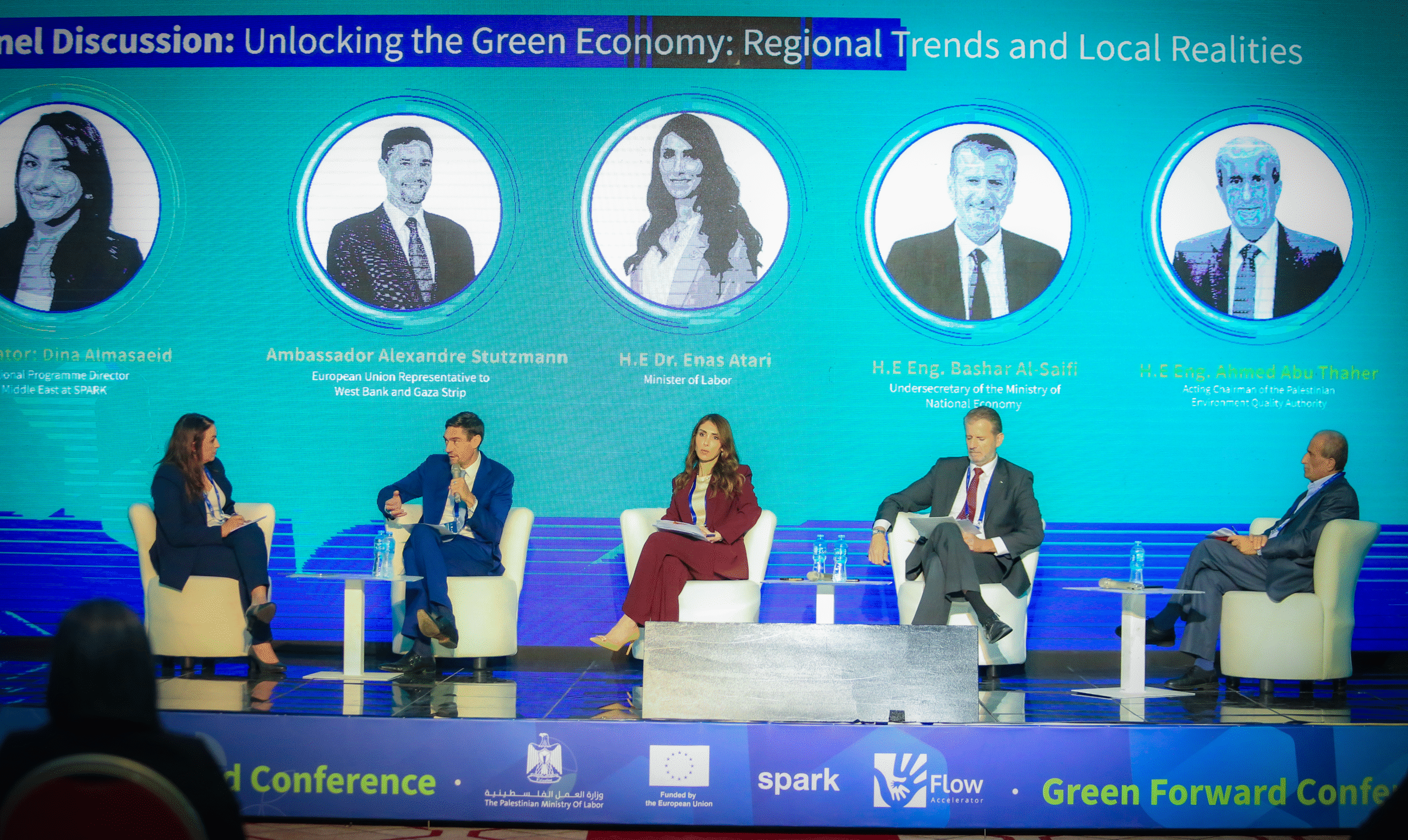
Panel: Unlocking the green economy; regional trends and local realities


Exploring how collaboration, regulations, and policy support can accelerate the transition toward a green and circular economy in Palestine and the wider region, this panel brought together influential policymakers and experts to frame the current state of the green and circular economy and uncover pathways for sustainable growth.
Panelists:
- H.E. Dr. Enas Atari: Minister of Labor
- His Excellency, the Undersecretary of the Ministry of National Economy, Eng. Bashar Al-Saifi
- Ambassador Alexandre Stutzmann: European Union Representative to the West Bank and Gaza Strip
- H.E Eng. Ahmed Abu Thaher: Acting Chairman of the Palestinian Environment Quality Authority
The discussion was moderated by Ms. Dina Al Masaeid, Regional Programme Director at SPARK, an international development executive with over 15 years of experience in education, entrepreneurship, youth empowerment, and human rights across the Middle East and Europe.
EU support: Driving regional and local green transitions

Ambassador Alexandre Stutzmann, European Union Representative to the West Bank and Gaza Strip, reiterated the EU’s steadfast commitment to supporting Palestine’s green transition through both financial and technical assistance.
“The EU has allocated a €47 million package to boost green investments, sustainable agriculture and food systems, resource efficiency, and renewable energy,” he said.
This investment forms part of a broader regional programme across the Southern Mediterranean, designed to promote inclusive and sustainable economic growth, through the empowerment of communities and partners. Ambassador Alexandre Stutzmann highlighted the EU’s collaboration with women entrepreneurs, SMEs, and Business Support Organisations (BSOs) to foster local ownership of the green transition and embed Palestine in the Southern Mediterranean region.
“We are working with enablers like BSOs to help SMEs transition towards greener business models while ensuring long-term market certainty,” he added.
Building skills and awareness: Ministry of labour at the forefront

H.E. Dr. Enas Atari, Minister of Labor, spoke about empowering youth and women through vocational training centres, cooperatives, and enterprise support initiatives aligned with the national employment strategy.
“Vocational training is not enough, it must go hand in hand with private sector readiness to absorb trained individuals and create sustainable employment,” she noted.
H.E. Dr. Enas Atari underscored the need for greater awareness of the green economy’s three dimensions: economic growth, social equity, and environmental protection. She called for closer collaboration between government institutions, BSOs, and the private sector to translate training efforts into real, lasting job creation.
Embedding green economy in national policy
H.E. Eng. Bashar Al-Saifi, Undersecretary of the Ministry of National Economy, underscored that integrating the green economy into Palestine’s economic framework is essential to ensuring long-term resilience.
“Despite the challenges of occupation and high unemployment, the green economy offers tangible opportunities for investment, energy independence, and sustainable job creation,” he said.
The Ministry has established a dedicated MSME Unit to support green enterprises and streamline business operations through new legal and regulatory reforms, with the aim to foster a more enabling environment for entrepreneurship under Palestine’s exceptional conditions.
Environmental leadership and institutional coordination
H.E Eng. Ahmed Abu Thaher, Acting Chairman of the Palestinian Environment Quality Authority, emphasised that environmental protection and economic development must progress hand in hand. His institution’s work focuses on resource efficiency, emissions reduction, and climate change mitigation, while also strengthening access to climate finance.
“We may not be a major emitter, but Palestine seeks to be part of the global climate solution while building a resilient local economy,” he affirmed.
The Authority’s initiatives align with key Sustainable Development Goals (SDGs), particularly those linked to sustainable consumption, biodiversity, and climate action, reflecting the country’s ambition to integrate sustainability into its economic future. H.E. Eng. Ahmed Abu Thaher also stressed that greater awareness of the green economy is key to boosting private sector engagement.
Building an enabling environment for green entrepreneurship
A recurring theme throughout the discussion was the need to establish a coherent, coordinated framework that enables green entrepreneurship and supports SMEs in their transition.
Ambassador Alexandre Stutzmann returned to highlight the EU’s priorities in scaling up green finance through derisked facilities, expanding access to funding, and improving regulatory environments. He stressed that collaboration among donors, BSOs, the private sector, and government institutions is key to unlocking new opportunities and building investor confidence in the green economy.
H.E. Dr. Enas Atari echoed this, noting that unified public policies and institutional coordination are essential to avoid duplication and bridge persistent gaps in financing, skills, and infrastructure, especially in Gaza. She urged closer integration of efforts between government institutions, civil society, international partners, and the private sector to convert short-term relief employment into long-term, sustainable green jobs.
“Green entrepreneurship cannot thrive in silos. It requires unified action, shared resources, and continuous dialogue across all sectors,” she emphasised.

Key takeaways for Business Support Organisations (BSOs)
- BSOs as enablers of SME green transitions:
BSOs can help small and medium-sized enterprises understand and adopt sustainable practices through tailored capacity-building, mentorship, and access to regional learning networks. As highlighted by Ambassador Alexandre Stutzmann, they are instrumental in connecting SMEs with derisked green finance and technical expertise provided through EU-funded mechanisms.
- Coordination and policy dialogue
Echoing H.E. Dr. Enas Atari’s remarks, BSOs can serve as conveners between public and private stakeholders, ensuring that policy reforms reflect market realities. Their participation in multi-stakeholder dialogue contributes to creating coherent, long-term strategies for green entrepreneurship.
- Strengthening access to finance
Many green entrepreneurs face barriers to financing due to perceived risks and limited collateral. BSOs can bridge this gap by helping SMEs prepare investment-ready business models, facilitating partnerships with financial institutions, and leveraging EU-supported green financing instruments.
- Addressing regional disparities
The panel noted the particular challenges faced in Gaza, where access to finance, infrastructure, and training remains limited. BSOs operating in these areas have a critical role in localising green innovation, developing small-scale, high-impact projects that create jobs while addressing local environmental challenges.
- Promoting inclusivity and awareness
Inclusive growth was a central theme throughout the panel. BSOs can play a pivotal role in promoting the inclusion of women, youth, and people with disabilities in green economy programmes. They can also amplify awareness around the economic potential of sustainability, positioning green growth as a pathway to competitiveness and self-reliance, not just environmental compliance.
The Green Forward conference in Palestine reaffirmed that while the road to a green and circular economy is complex, it is also filled with opportunity. Through collaboration, innovation, and empowered BSOs, Palestine can build a more resilient, inclusive, and sustainable economic future.
—
Green Forward is a European Union-funded initiative implemented by a consortium of partners working across three complementary levels:
- Expertise France (at the macro level): leads the development of enabling green policies, legislation, and standards in close collaboration with national authorities and regional stakeholders.
- SPARK (at the Meso level): focuses on strengthening the capacity of Business Support Organisations (BSOs) to act as effective ecosystem enablers.
- UNIDO (at the micro level): supports small and medium-sized enterprises (SMEs) through targeted technical assistance, promoting the adoption of circular economy practices and improving access to green finance.
Related news
-
![]() News
NewsGreen Forward (Meso): Empowering Egypt’s green transition through business support organisations
-
![]() Event
EventBuilding sustainable futures: Erbil forum paves way for localisation in Kurdistan Region
Multi-stakeholder gathering brings together government, local private companies, and civil society to strengthen local ownership and reduce international aid dependency
-
![]() Event
EventSPARK at MENA YES! 2025: Supporting youth in the green economy — The critical role of Business Support Organisations
-
![]() News
NewsPathways to economic recovery in Syria: 10 recommendations from SPARK’s Damascus scoping mission
-
![]() Event
EventPalestine Launchpad Job Fair 2025
-
![]() Report
ReportSPARK 2024: Annual report highlights
The Annual Report provides comprehensive information on SPARK’s activities throughout the preceding year. Published with the approval of the Supervisory…
-
![]() Event
EventJordan hosts Green Forward (meso level) conference 2025 to advance the green and circular economy
-
![]() Event
EventLebanon: Green Forward conference 2025 (meso level) to propel Lebanon’s green and circular economy transition
-
![]() News
NewsKey learnings and insights from the Green Growth Summit Cairo 2025
-
![]()
Advancing the circular economy in MENA: Key takeaways from the first Green Forward webinar
-
![]()
Palestine Launchpad with Google Hackathon Connects Local Talent with Tech Companies
-
![]()
Lebanon’s wastewater crisis needs local solutions: A new policy paper makes the case for decentralised systems
-
![]()
“Work for Work” Campaigners Share Outcomes at Major Press Conference in Sulaymaniyah